Most B2B companies don’t fail because of their product or service. They fail because they go to market with vague messaging, generic campaigns and disconnected efforts across sales, marketing and service.
At SUM Digital, we often hear the same frustrations from B2B leaders:
“Marketing isn’t bringing in quality leads.”
“We’re getting traction, but it feels random.”
These aren’t just growing pains - they are the symptoms of a fractured strategy. If you’re not seeing results from all the marketing and sales efforts you’re putting in, it’s often not about your product or service. Your go-to-market strategy - or lack thereof - might be the cause.
Just stop and answer these questions for yourself:
Are you sure who is your ideal customer and what do they actually want?
Is your website your pride and joy - or is it holding you back?
Can your team clearly articulate why you’re different from the competition?
If these questions make you pause and hesitate, you’re likely experiencing the go-to-market (GTM) gap. You feel the pain in the form of low quality leads, flat conversion rates and total uncertainty about where to launch or how to scale.
To overcome this, you need a go-to-market strategy: a clear blueprint that aligns your marketing, sales and customer success teams around a unified plan to attract, convert and retain the right customers.
What is a go-to-market strategy?
Behind the fancy acronym, it’s simple. A GTM strategy is a structured roadmap for how a company brings a product or service to market and wins customers.
In B2B, it aligns:
- who you sell to,
- what problem you solve,
- where you reach them,
- how you win.
Your go-to-market strategy might already live in your head, but not on paper for your whole team to read. Putting this on paper is vital, as a clear GTM strategy saves you a lot of time and resources later. I’ll explain exactly why in the next paragraph.
In short, a go-to-market strategy is the bridge between your product or service and predictable revenue. It helps turn random traction into growth that feels systematic.
What is the difference between a marketing plan and a go-to-market strategy?
Many founders confuse a go-to-market strategy with a marketing plan. While a GTM strategy describes the full process of bringing your product or service to customers, a marketing plan delves into the specifics of communicating about that product or service. A marketing plan is then one of the components of a go-to-market strategy.
Think of a GTM as the North Star for all your marketing and communication. Your go-to-market strategy (or lack thereof) determines your marketing plan, its execution and its success.The sooner you figure out the most pressing GTM questions, like your unique selling point and ideal customer, the less time and resources you’ll burn on marketing later.
If you’re still figuring out your Ideal Customer Profile (ICP) or positioning, your messaging might not land and you will fail to attract the right leads. The same counts for going to market with generic, one-size-fits-all messaging when in reality, your product is not and shouldn’t be for everyone.
These questions are often the hardest. But answering them is one of the most valuable things you can do for your business. Let’s unpack each of them in more detail.
The elements of a go-to-market strategy
A strong go-to-market starts with clarity:
- Who exactly are we selling to?
- What are we saying to them - and why should they care?
- Where do we focus our limited resources for maximum impact?
Who are we selling to?
This step involves defining your target market with surgical precision. Are you selling to big corporations, SMEs or startups? Are you targeting early adopters who crave innovation or a mature market where you need to win customers away from established competitors?
In B2B, "Who" is a two-part answer:
- The Ideal Customer Profile: the type of company that gets the most value from your product (e.g., "mid-sized SaaS companies in Northern Europe with 50-200 employees").
- The Buyer Persona: the individual within that company who signs the quote or uses the tool (e.g., "Head of Operations" or "CTO"), and other customer insights that complete the persona.
Your ICP should focus on the firmographics (industry, company size, annual revenue, geographic location and tech stack), while your buyer persona includes their job title, daily pain points, professional goals, and what keeps them up at night.
If you only define the company (ICP), your marketing will be too broad. If you only define the persona, you’ll waste money showing ads to people at companies that can’t afford you. You need both.
What are we saying to them - and why should they care?
This is where your value proposition comes to life. If you can’t clearly articulate why you are the better choice - whether through a unique methodology, specialized focus or a superior price-to-value ratio - your customers won’t figure it out for you.
Think about:
- Positioning: How you sit in the customer’s mind compared to the status quo.
- Messaging: The actual words you use to describe the transformation you offer.
- Packaging (if applicable): How you bundle your solution to make it easy to buy.
Adjust your positioning around clear customer pain points and build messaging that explains your value in clear, differentiated terms. Most B2B marketing fails because it focuses on features instead of outcomes. Using a framework like StoryBrand, we shift the perspective: Your customer is the hero, and you (or your product) are the guide helping them overcome a specific villain.
The goal is to move from "We have these 5 features" to "We solve this expensive problem so you can achieve this specific result."
Where do we focus our limited resources for maximum impact?
This is where your go-to-market strategy meets the real world. With your positioning and messaging on paper, you can build a marketing plan that helps you convert leads into customers.
You might use inbound marketing - attracting customers through content, SEO and social proof or outbound - proactively reaching out to your ICP via LinkedIn, email or calls. The ideal strategy depends on where your customers are and what channels they use.
To ensure your sales and marketing teams aren’t operating from different assumptions, you need to map the customer journey. At SUM Digital, we use the Customer Timeline Canvas to visualize the path from a customer's "first thought" (realizing they have a problem) to "ongoing use" (becoming a loyal advocate).
Mapping this timeline allows you to see exactly where leads are falling out of your funnel and helps you serve your customers better at each stage.
GTM strategy: your quick-start checklist
-
Target audience: Which specific companies (ICP) and roles (Buyer Persona) are my "best-fit" customers?
- Value proposition: What is the primary, undeniable reason a customer should choose me over the status quo?
- Positioning & messaging: How do I describe my solution so that it feels unique, differentiated and relevant?
- Demand generation: Which specific channels will I use to build my pipeline?
- Customer journey: Are sales and marketing perfectly aligned on how a lead moves from "first thought" to "ongoing use"?
How a go-to-market strategy helps you achieve predictable growth
If you’ve read until here, you know what a go-to-market strategy is really about. It’s about removing the “maybe” from your growth and turning it into a predictable system.
You’ve already done the hardest part - building a company that solves a real problem. But to move from those first few ad hoc wins to a systematically growing business, you need more than random acts of marketing.
When your ICP, messaging and distribution channels are in sync, growth stops being a series of random events. You stop wondering where your next lead is coming from and start focusing on how to handle the influx of the right leads.
A formal GTM strategy doesn't just save you time; it gives you the confidence to double down on what works. If you're ready to stop guessing and start building your growth system, I’d love to help you think it through.
I set aside one hour every Friday specifically to help founders and marketers tackle these challenges. No need to overthink it - book a free 20-minute 1:1 below and we can dive into your strategy in Dutch or English.
📅 Book an Office Hour session here
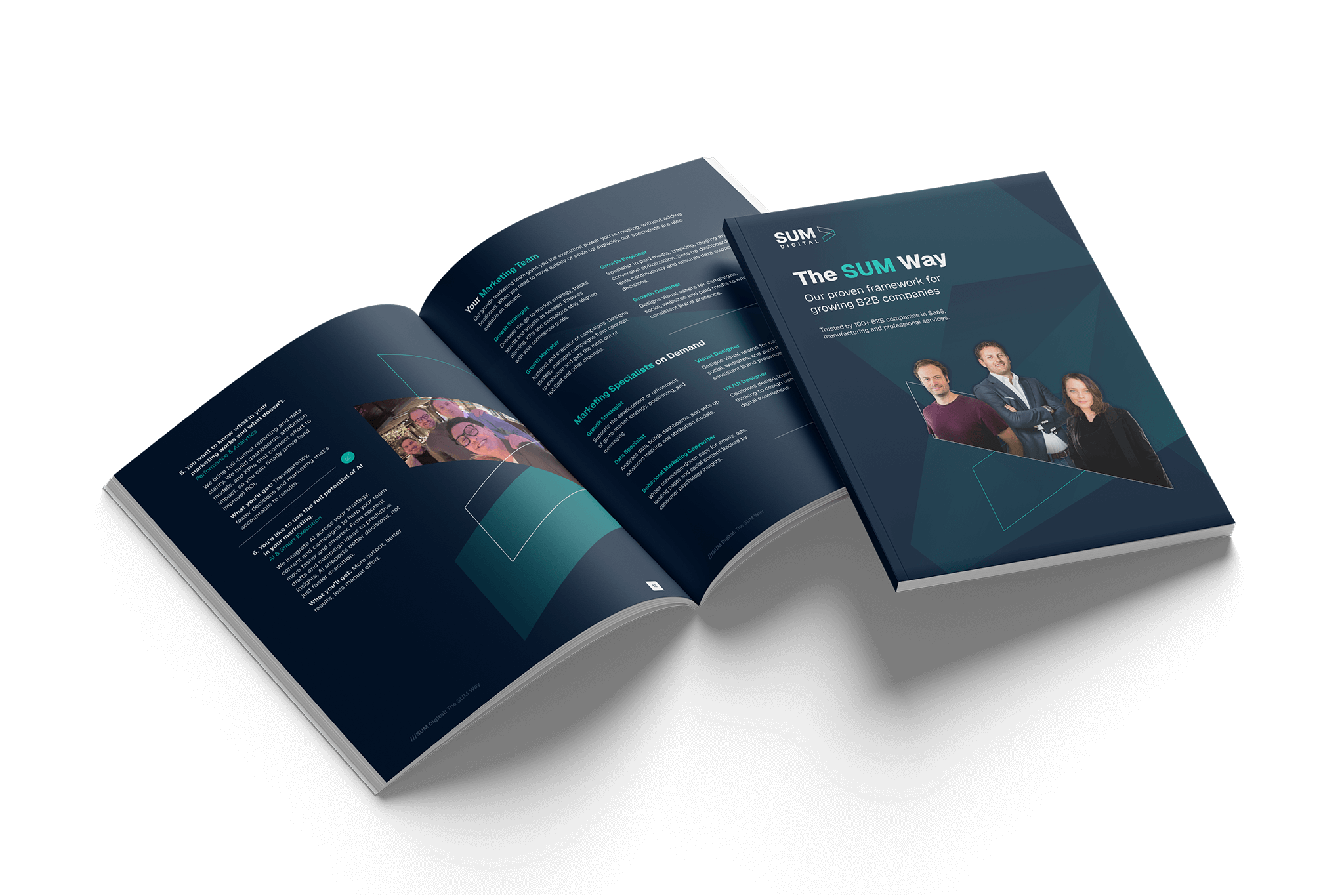
The SUM Brochure
Discover how we think, work and deliver. Inside, you'll find out how our way of working and the SUM Growth Model helps businesses like yours achieve results and grow predictably.
 Download Now